The international collective Philosophy, Critique, and 'AI' (PCAI)
consists of early career researchers working on questions regarding
‘Artificial Intelligence’ (AI) from a predominantly philosophical perspective.
The PCAI group seeks to foster space for politicised philosophical reflection
on ‘AI’, while refusing to succumb to overly simplistic characterisations of either ‘salvation’
or ‘demise’.
The collective understands techno-scientific practices to be situated within social structures that are in turn embedded in logics
of domination. As such, we recognise that political reflections on ‘AI’ should be
approached through a plurality of different critical theoretical lenses (e.g., sociopolitical,
epistemic, normative), which pertain to minoritised (e.g., feminist, decolonial, queer)
perspectives.
Being a collective, PCAI creates such space through various activities where we reflect on
how and why critical theorisations are carried out, and also question how the
term ‘AI’ is (continuously) constructed, used, and enforced.
2026/2027
Work in Progress 3: 11.01.2027; 17h-18h CET – TBD (online)
If you would like to present your work, engage in a discussion, and receive feedback from the PCAI group, email us!
(PCAI email at the bottom of the website)
Reading Session 2: 07.12.2026; 17h-18h CET – Alternative Digital Futures (online)
Check back in October!
Reading Session 1: 02.11.2026; 17h-18h CET – Techno-Authoritarianism (online)
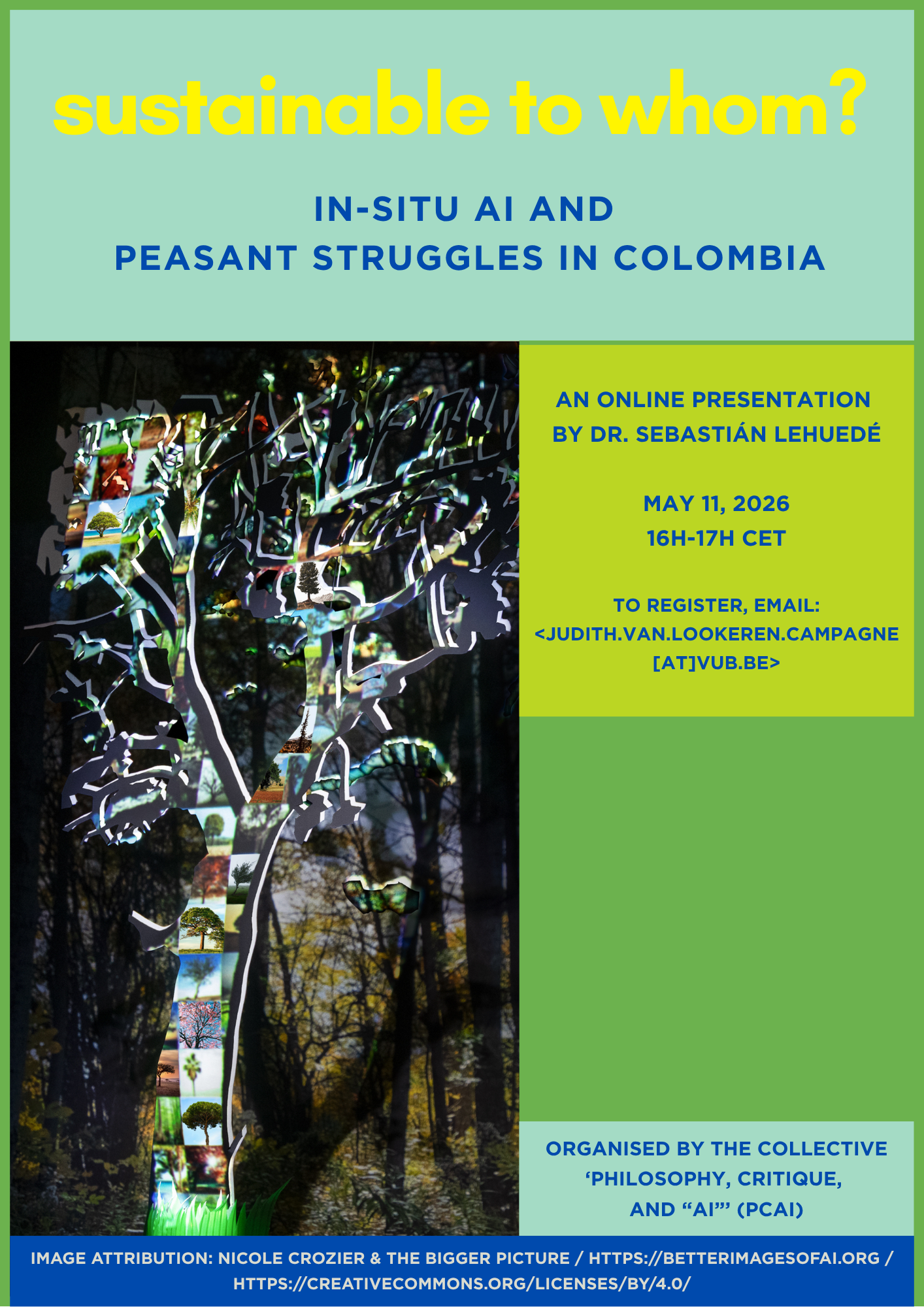
Presentation 6: 11.05.2026; 16h-17h CET – Dr. Sebastián Lehuedé, King’s College London (online)
Sustainable to Whom? In-Situ AI and Peasant Struggles in Colombia
Many 'AI for sustainability' initiatives pursue ambitious goals such as emissions reduction,
yet local impacts and alternative approaches have been largely overlooked. Drawing on
ethnographic fieldwork in Colombia, this talk analyses two initiatives: one by Microsoft
in the Amazon and another by peasant communities in the High Andes. Through this analysis,
it traces the emergence of 'in-situ AI', highlighting its capacity to engage with local
ecological struggles and address environmental injustices. Nevertheless, questions remain
about the capacity of in-situ AI to address urgent, planetary-scale environmental challenges.
Work in Progress 5: 15.04.2026; 16h-18h CET – Eloïse Soulier (online)
Cyborgs, care robots, robodogs: is the idea of relations to machines feminist?
Feminist philosophy in general has paid particular attention to relationality,
as a reaction to the Western Enlightenment ideal of atomistic rational selves that has
served to exclude many, including women. For some feminists, this humanist ideal places
women on the side of the non-humans and grounds the need for a posthuman philosophy of
interconnected and interrelated beings. But in a world where machines are so deeply intertwined
with capitalist exploitation and masculinist ideologies, is it furthering feminist purposes
to consider that we have relations to machines?
Eloïse Soulier is a PhD candidate and research associate in the Ethics in IT
Research Group at the University of Hamburg, chaired by Professor Judith Simon.
Her dissertation work explores relational conceptions of autonomy and what these
can contribute to the discourse on human autonomy in the context of digital technologies,
drawing from feminist moral philosophy. More broadly, drawing from feminist epistemology
and feminist philosophy of language, she researches the ways in which our conceptual choices
shape the – digital - realities we live in, and whether and how we can act on it.
Kraft, A., & Soulier, E. (2024, June). Knowledge-enhanced language
models are not bias-proof: Situated knowledge and epistemic injustice in AI.
In Proceedings of the 2024 ACM Conference on Fairness, Accountability,
and Transparency (pp. 1433-1445). https://dl.acm.org/doi/abs/10.1145/3630106.3658981
Reading Session 4: 25.03.2026; 16h-18h CET – Borders (online)
We also suggest as complementary reading Chapter 2 of Petra Molnar's 2024 book,
The Walls Have Eyes.
Work in Progress 3: 28.01.2026; 13h-14h CET – Marilou Niedda (online)
Epistemic Truth and AI: a Feminist Epistemology reading from a Critique of ‘Objectivity’
This work-in-progress presentation is on the first/second chapters of my PhD dissertation.
I work on feminist and decolonial epistemologies, applied to AI reflections on ethics through
an empirical case-study in a research centre in the UK. (i) My first argument is about the belief
that mathematically driven technologies can be more 'objective' in their showcasing of reality.
This grants epistemic authority to engineers of AI technologies, which sort of erases the importance
of subjective experiences within the making of AI systems. Therefore, (ii) this influences people's
true perceptions of reality, which is often conflated with objectivity (objectivity <-> reality).
This reinforces the general view that AI is socially preferential for the good of humanity, and
pushes for a positivist account of reality in the Global North. I finally (iii) explore the
possibility for a contextualist framework of truth through the experience of AI, to 1) restore
objectivity as situated assumptions, 2) to nuance the impact of AI technologies to create meaning
within social reality.
Reading Session 2: 15.12.2025; 15h-16h30 CET – Technosymbiosis (online)
Hayles, N. Katherine, 'Technosymbiosis: Figuring (Out)
Our Relations to AI', in Jude Browne, and others (eds),
Feminist AI: Critical Perspectives on Algorithms, Data,
and Intelligent Machines (Oxford, 2023; online edn,
Oxford Academic, 23 Nov. 2023), https://doi.org/10.1093/oso/9780192889898.003.0001
Reading Session 1: 20.11.2025; 15h-16h30 CET – Is Bias Mitigation Enough? (online)
Drage, E., & Frabetti, F. (2023). The Performativity of AI-powered Event Detection:
How AI Creates a Racialized Protest and Why Looking for Bias Is Not a Solution.
Science, Technology, & Human Values, 49(5), 1045-1072. https://doi.org/10.1177/01622439231164660
2024/2025
Reading Session 6: 18.06.2025; 17h-19h CET – ‘What’s ‘Good’ in ‘Good AI’? (online)
To wrap up the academic year, we organise a final reading and discussion session on the
question ‘What’s ‘Good’ in ‘Good AI’? We will be discussing a chapter from
Simon Lindgren’s Critical Theory of AI (2023) and an article written by
Mona Simion entitled "Two Dilemmas for Value-Sensitive Technological Design" (2024)
in the Feminist Philosophy and Emerging Technologies handbook.
The aim is to (notably) discuss our preconceptions of what a 'good',
less harmful or evaluative AI could be/is thought to be in our current neoliberal economy.
11:00 Introduction (Judith Campagne and Marilou Niedda)
Session 1 Chair: Judith Campagne
11:15 – 11:45 Anthony Longo (Antwerp University): ““Un-Boxing the Algorithm: A Phenomenological Response to the "Black Box Metaphor".”
11:45 – 12:15 Eloïse Soulier (University of Hamburg), “Concepts, normativity and AI: two approaches”
12:15 – 12:30 Break
Session 2 Chair: Eloïse Soulier
12:30 – 13:00 Judith Campagne (Vrije Universiteit Brussel), “Contesting the Contesting of Automation”
13:00 – 13:30 Kim Ann Woodley (Ruhr University Bochum), “Debunking the historical stigmatisation of emotions in computational emotion recognition”
13:30 – 14:15 Lunch
Session 3 Chair: Kim Ann Woodley
14:15 – 14:45 Heather McKnight (Brighton): "Nano-Utopian Temporalities in The Darkness of the Lived AI - Exploring Intimacy, Identity, Language and Law" [online]
14:45 – 15:15 Marilou Niedda (Utrecht University) “Epistemology of ignorance and datafication – To interrogate the necessity for secrecy in AI through marginalised groups’ experiences”
16:00 – 16:30 Michiel De Proost (UGent), “AI ethics and the diversity of forms of life: A feminist perspective”
16:30 Wrap up and Farewell
Organisation: Marilou Niedda (Utrecht), Eloïse Soulier (Hamburg),
Marte Henningsen (Maastricht), Kim Ann Woodley (Bochum), Judith Campagne (Brussel).
With support of the Centre for Ethics and Humanism (ETHU), Vrije Universiteit Brussel.
Paper Presentation 4: 09.04.2025; 17h-19h CET – Asher Kessler (online)
On the 9th of April, we are excited to welcome Asher Kessler, who will present
his latest paper "Longtermism, Big Tech, and the Rebalancing of Historical Time:
A Benjaminian Critique", in which he discusses the perception and valuation of time
in the big tech industry in the Silicon Valley.
Asher is currently finishing his PhD at LSE in the Media and Communications
department. His research focuses on Facebook/Meta, where he examines how
high-level actors in and around the company came to think and speak about
time, space, and their ability to change the world around them.
He analyses how actors in and around Facebook/Meta utilise the
language and times of progress and exponentiality to produce a
sense of historical time which is preoccupied with the future.
There will be a 20-minute presentation followed by a Q&A and discussion.
Reading Session 3: 11.12.2024; 17h-19h CET – Cyberfeminism (online)
Plant, Sadie, From “Scattered brains, neurotics” to “Intuition”,
then from “Wetware, dryware, silicon” to “quanta”.
In Zeros + Ones: Digital Culture Women and the New Technoculture. 1998.
Adam, Alison, Chapter 9 “The Ethical Dimension of Cyberfeminism.”
In Reload/Rethinking Women + Cyberculture, 158-174.
Edited by Mary Flanagan and Austin Booth, 2002.
Reading Session 2: 06.11.2024; 17h-19h CET – Problematizing ‘AI’ through datafication (online)
Katz, Yarden. “Artificial Whiteness.” In Artificial Whiteness.
Politics and Ideology in Artificial Intelligence, by Yarden Katz,
153-182. New York: Columbia University Press, 2020
D’Ignazio, Catherine; Klein, Lauren. F. “Collect, Analyze, Imagine, Teach.”
In Data Feminism by Catherine D’Ignazio and Lauren F. Klein,
49-73. Cambridge: MIT Press, 2023
Reading Session 1: 25.09.2024; 17h-19h CET – Starting point Philosophy, Critique, and ‘AI’ (online)
Browne, Jude. “AI and Structural Injustice. A Feminist Perspective.”
In Feminist AI. Critical Perspectives on Data, Algorithms and Intelligent Machines,
edited by Jude Browne, Stephen Cave, Eleanor Drage, and Kerry McInery, 328-346.
Oxford: Oxford University Press, 2023.
Gebru, Timnit, and Émile P. Torres. 2024.
“The TESCREAL Bundle: Eugenics and the Promise of Utopia through Artificial
General Intelligence”. First Monday 29 (4). https://doi.org/10.5210/fm.v29i4.13636.
Team
Founders
The PCAI was initiated in 2024 by Marilou Niedda (Utrecht University)
and ETHU-member Judith Campagne (Vrije Universiteit Brussel).
Organisation Team 2026/2027
Marilou Niedda
Utrecht University
Eloïse Soulier
University of Hamburg
Kim Ann Woodley
Ruhr-University Bochum
Heather McKnight
Magnetic Ideals
Laura Hernández
Università di Macerata
Past Organisers
Judith Campagne
Marte Henningsen
Join us!
The collective is for early career scholars at any stage in their PhD/post-doc working on
critical philosophical approaches to ‘AI’.
If you would like to join next PCAI events, please send an email to: pcai[dot]hazelnut328[at]passfwd[dot]com.